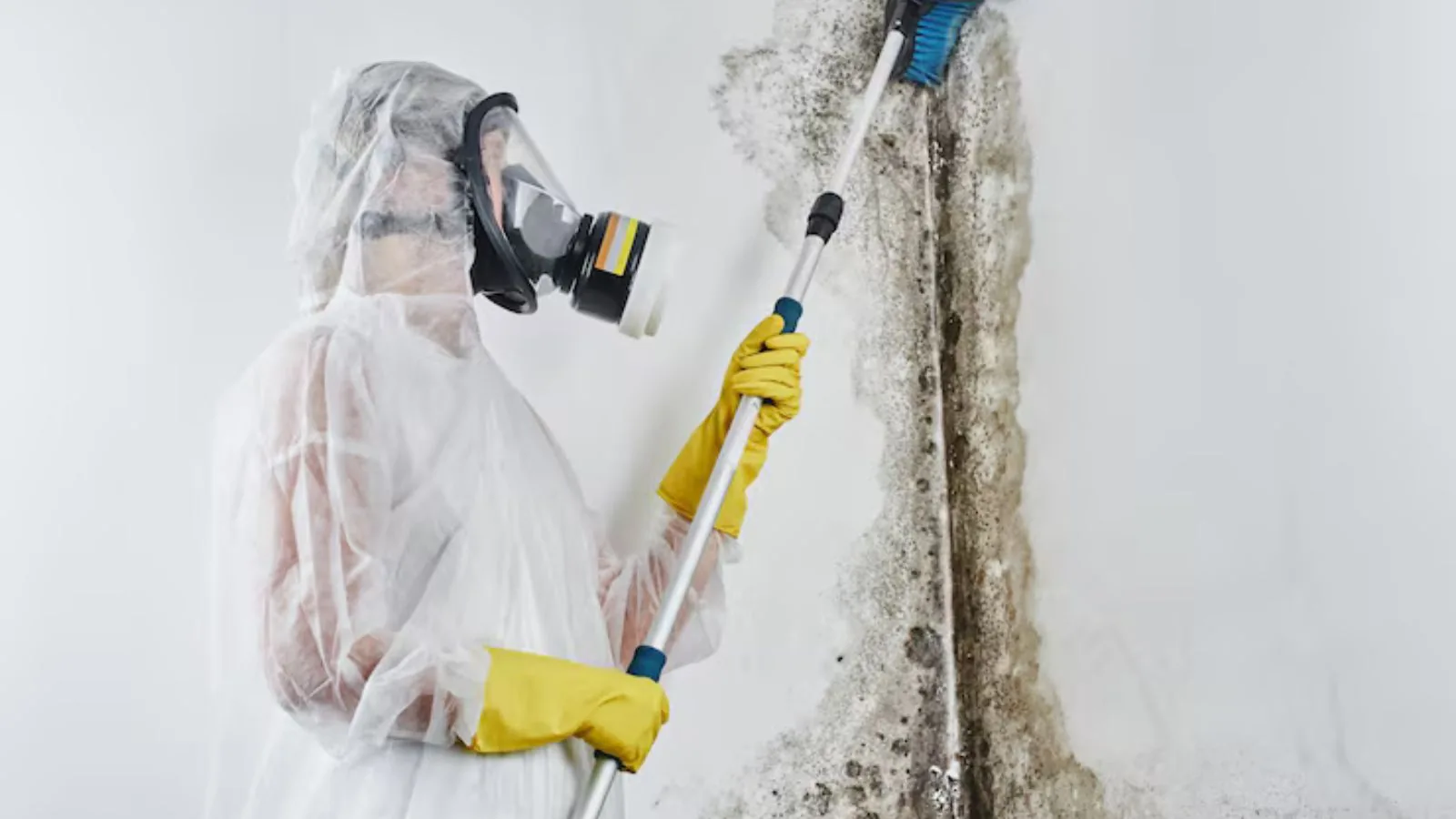
People call dark or black growth black mold, but color does not identify a type. Many molds look dark. Only testing by a qualified person can say what is present, and the cleanup steps are the same for most growth indoors.
This guide covers what to do and what to avoid. It does not describe health effects. For health concerns, speak to a doctor.
What to do first when you see dark growth
First steps for dark mold
- Stop the water. Fix the leak or reduce the humidity feeding it.
- Do not dry-brush, sand or scrub a large patch, since that can spread particles.
- Keep the room closed off and turn off fans that blow across it.
- Photograph the area and note when you found it.
- Decide whether the area is small and on a hard surface, or larger and on porous material.
A rough rule from EPA guidance is that areas under about 10 square feet can often be handled by the occupant, if the material is hard and the person is careful. Larger or porous cases are better handled by professionals.
How removal differs by material
| Material | Usual action | Why |
|---|---|---|
| Tile, glass, metal, sealed wood | Clean with detergent and water, dry fully | Non-porous, surface only |
| Unfinished wood | Clean, dry, sometimes sand by a professional | Growth can go deeper |
| Drywall | Cut out and replace | Paper and gypsum hold growth |
| Carpet and pad | Remove and replace | Porous |
| Insulation | Remove and replace | Holds moisture |
If the growth is on drywall, painting or spraying does not solve it. The wall is usually opened and replaced after the moisture source is fixed.
Why it keeps coming back
Black or dark growth returns when moisture stays. Common causes are a leaking pipe, a damp basement wall, poor bathroom ventilation or condensation on a cold surface. Cleaning the surface without fixing the source buys a few weeks.
- Run bathroom fans during and after showers.
- Use a dehumidifier in basements during humid months.
- Fix leaks and dry wet materials within a day or two.
- Keep gutters and downspouts clear and pointed away from the foundation.
- Move stored items an inch or two off exterior basement walls.
Do you need a test?
Testing can show types and levels in the air or on surfaces. It does not replace removal, and it is not required for visible growth. It can help when the source is hidden, when a buyer or lender asks for documentation or when you want a baseline before and after.
When to bring in a professional
Call a professional if the area is large, if growth is behind walls, if it followed sewage or flood water or if you cannot find the cause. A good provider will inspect, write a scope, contain the area and use independent testing afterward. See mold remediation for the process.
Dark spots that may not be mold
Not every dark patch is mold. Dirt, soot, mildew from dust and some stains look similar. A quick check is to dab the spot with a drop of household bleach on a hard surface. If the spot lightens quickly, it is often mold or mildew. If it does not change, it may be dirt. This is a rough check, not a test.
Odor and context help too. A musty smell and a history of moisture point toward mold. A dark smudge near a vent or candle points toward soot. When in doubt, have an inspector look.
Dark mold in Woodridge basements and bathrooms
In older Woodridge homes, dark growth often appears in basement corners, behind stored boxes and on bathroom ceilings without exhaust fans. Illinois now requires mold remediation providers to register with the Illinois Department of Public Health under Public Act 103-0893. Ask any provider about registration.
For help in your area, see the Woodridge service area page.
Dark mold you cannot explain?
Call the line to talk through inspection and removal.
Call (630) 580-6401Black mold questions from Woodridge homeowners
No. Color does not identify a type. Many molds look dark. Testing by a qualified person is the only way to know.
Small spots on hard surfaces may be cleaned carefully. Larger growth or growth in porous materials should be handled by professionals.
Bleach cleans hard surfaces but does not reach porous materials. It does not fix moisture.
Because moisture is still present. Fix the source and dry the area.
That is a decision for you and your doctor. This page does not make health claims about mold.
It depends on the cause and policy. Mold after a covered water loss may be covered with limits. Ask your insurer.
Sources and standards: U.S. EPA guidance on mold cleanup, the ANSI/IICRC S520 Standard for Professional Mold Remediation and Illinois Public Act 103-0893. These are general references and not health advice.